I have the (always slightly shocking) privilege of teaching a writing workshop today. It’s on the practice of florilegia, applied to the craft and play of poetry.
In the spirit of creative play, and in honor of those who choose to write with me, I began my morning arranging a florilegium—also known as a type of found poem, sometimes also known as a cento—from the quotations that circled and splashed as I watched the waves from the northernmost sand of my local beach.
Florilegia means gathering flowers, and that is absolutely how the practice of choosing phrases from among the works of others feels to me. A slow practice: intuitive, guided by pleasure. This is as true when I am wandering through poems I have memorized as it is when I’m reading. Either way, dropping into a sort of wide-angle vision aids in the discovery of pattern, pleasure, presence. I don’t always remember to do that, but I did this morning, and maybe it’s what led me to the additional gifts of the wrackline.*
The ocean has moods, like all of us; the same beach will be different tomorrow than it was today, as I will. Recognizable, usually—there’s an enduring substrate, a slope, and general weather patterns, and there’s what everyone already expects to see—but not static.
Yesterday, for example, the wave-wash made intricate patterns on itself: folding and pleating geometrically, precise and easy, edging its work with delicate lace. This morning the waves made demands. They were playful, but you couldn’t miss their force. And they brought gifts.**
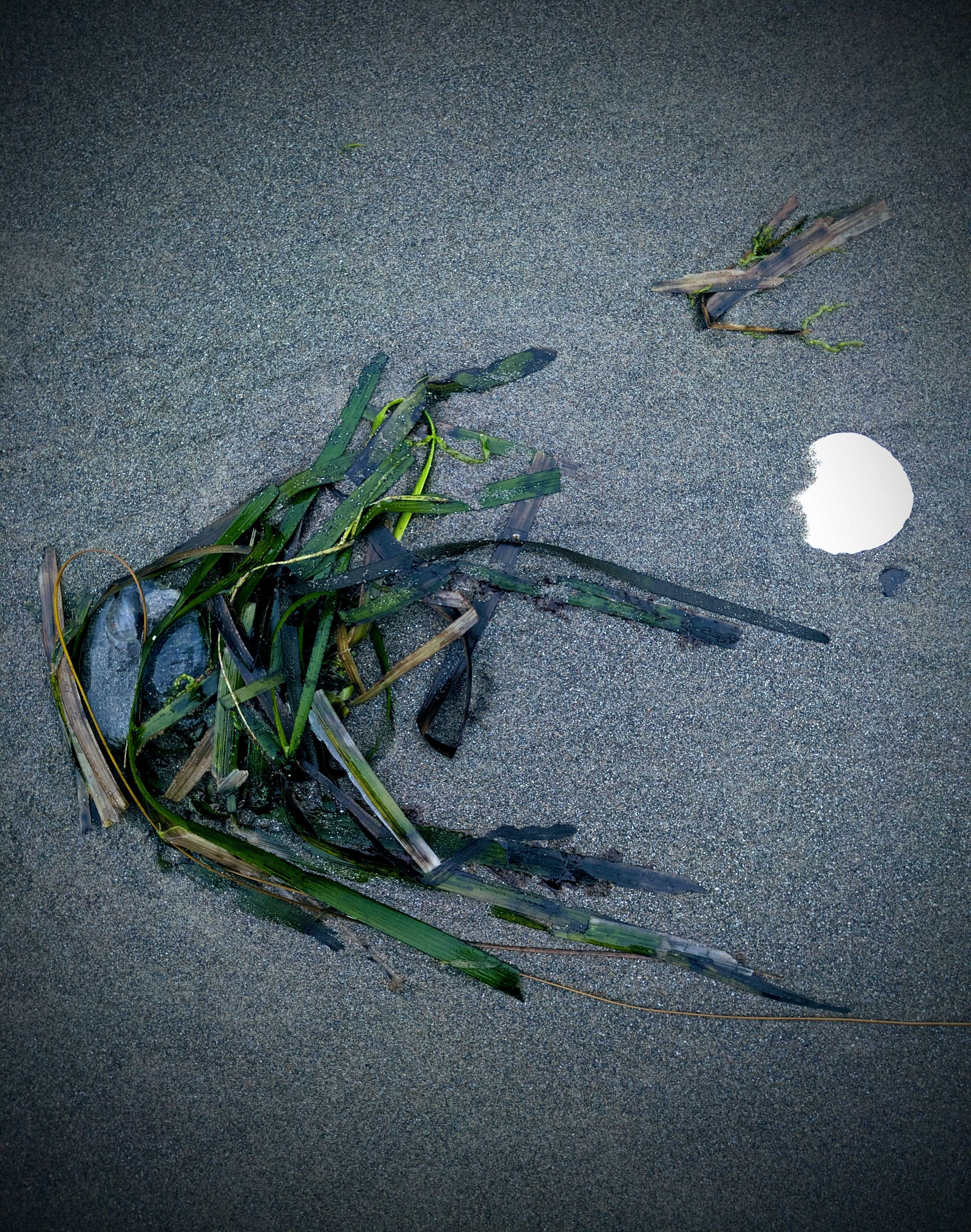
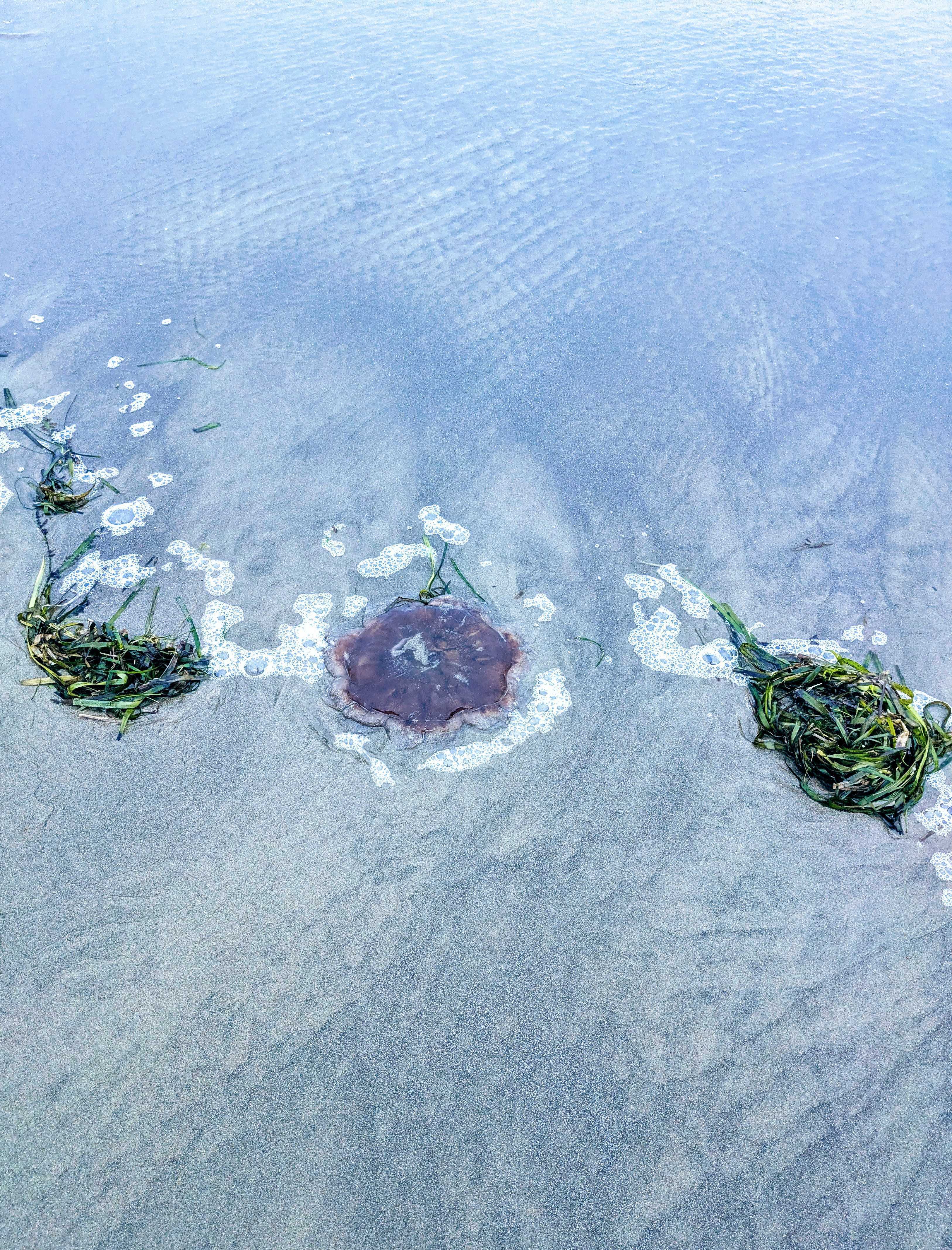
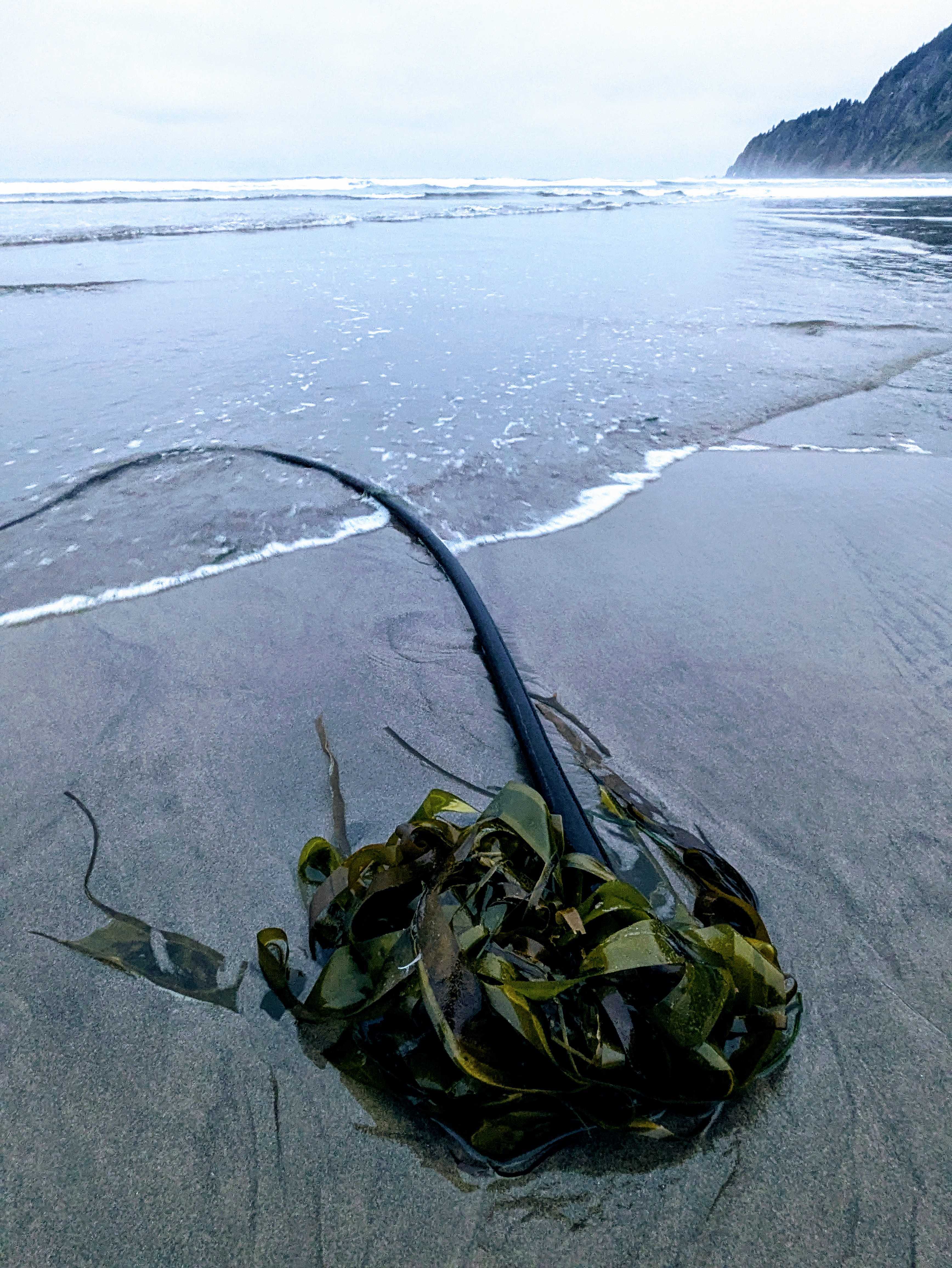
The first poem I published features the wrackline prominently. It’s a metaphor, I guess, but that wasn’t the intention. I write what I see.
It re-appears in my composition—and honestly, I try to keep it out of a final poem, for reasons of not repeating myself without reasonable craft and cause. Sometimes I give in; it’s very persistent. I’ve noticed I tend to say the wrackline, as if it were a single continuous being regardless of location or appearance. Maybe that’s what I see.
I have been to the beach often this week, sometimes two and three times in a day. I’ve made a number of beach offerings, and less formal temporary art installations. That number is more than three, but none of them were a triptych. “Things take the time they take.” And the form.
I thought, for this final week of The Threshold Project, that I might arrange three florilegia***, but that didn’t happen either. So I accept the gift of the wrackline, and I offer you my photographic interpretation of it. Today’s wrackline felt a threshold in itself. I stepped over and over and over it with care. I may have danced a little.
And I “made” this poem. I say that in quotes because, although it is arranged by me, it was composed by many.**** And I offer it to you.
When the world overwhelms,
get to moving water.
Sit there. Sit there. Sit there.
Things take the time time they take.
All hurry is violence.

There's a thread that you follow;
you have everything you need.
Expectations either harm, or heal.
How you play — this is what you win.
And wrackline
               implacably
                             delivers.
*Spellcheck et al. forever reminds me that this ought to be written as two words. I disagree.
**Or the wreckage of a tantrum, or assorted items loved and discarded like a faerie queen’s favorites. The ocean has moods. Specifics are interpretation.
***I use the name to refer to arranged pieces in the plural, as well as to the practice.
****Florilegium arranged Tara K. Shepersky. Individual lines (in order) copyright Tara K. Shepersky, Martin Shaw, Mary Oliver, William Stafford, Lucy Bellwood, Ursula K. LeGuin, Tara K. Shepersky. If you count that out you’ll find more lines than attributions. This is because two of these lines are general, without copyright, but I also do not claim them as my own. They are: “Expectations either harm or heal” and “All hurry is violence.”


Whenever I am troubled, I tend to want to sit by the sea. I love the ocean and its infinite moods.
Sitting by the sea, usually in a car given my physical disability, always soothes my soul. I like to joke that it’s good for my constitution (recalling when they sent women to the sea to convalesce).
Whenever I am troubled, I think about the sea. ~Joan Didion
LikeLiked by 1 person