I was in my 20s the first time someone suggested I write a personal mission statement. I nodded seriously, listened to their outpouring of enthusiasm for the practice—and declined, in the privacy of my daily life, to do any such thing. God, how embarrassing: to be so earnest out loud.
In my 30s I worked in tech, in a decade* when mission statements, vision statements, and company values were prominently featured on websites and corporate swag. I remember a lot of effort (and money) spent on developing and disseminating and attempting to do our jobs by our Core Values. Integrity, Transparency, Urgency, Grit, “Don’t be Evil“—that sort of thing. We failed a lot, of course, which is just being human. That the companies failed our values is just being companies under capitalism: profit is always going to be the unstable base on which any other core value has to be constructed. It’s the bottom line.**
Still, I was (I am) sympathetic to the exercise. I had early training in thinking about values, and it wasn’t a huge step to learning the names of mine, and writing them down. From there, to periodically assessing both them and myself, adjusting as needed. In important ways, this process continues to shape my relationships, daily life, leisure, work.*** I don’t have a personal mission statement. (I’m not convinced I can know what the mission of a human person might be.) I absolutely have core values.
Core, as in: at the center of my being. Cor(e) as in: written on my heart.
And yeah, I’m mildly embarrassed to write that, but not embarrassed enough not to. Because I am that earnest, I always have been, and I’ve finally learned to roll with it. Sometimes also while I’m rolling my eyes. (I like that tension, as a check for myself: is this ridiculous? Is it important?)
If, instead of an essay, the format of these reflections was a speech, I imagine a hand or two would be up by now. What is all this corporate-speak doing in The Threshold Project? I set up a “creative play project,” right? Did I get sick of the “creative” and “play” parts?
To be honest, those do get tiring. Play and creativity are shape-changing and time-bending and impossible to quantify. Exhausting, see? But no, I’m not abandoning them. The opposite. Because the soul of a creative play project is values.
Maybe that isn’t how all artists experience the kind of thing I’m doing here. What’s it like for you? For me, values are what I’m trying to learn, discern, explore. (Something I’ve learned: I value a good anti-capitalist forcing function.) I don’t think it’s coincidence that a new creative play project showed up in a crux of personal ferment, emergence, and shift. It’s not like I needed something else to do. But I probably need this thing.
I’ve been challenged recently to evaluate my relationship to expectations. Of which I have a lot, of myself in particular. I’ve been trying to parse how they function in my life. When I’m thinking something out, I sketch. (Or write. Or talk. To you, possibly; you’re welcome and I’m sorry.) Expectations, I thought suddenly (in sketch-form), either help or they harm.
This is a variant of something I heard on a radio show a long time back. I think the phrasing was “Architecture either harms or heals.” It was, of course, an architect speaking, of their own core values.
I’ve used it since—sometimes daily—to think about design of many kinds (software, curriculum, project), and it’s guided me well enough, for long enough, that it’s become something akin to a core value. A core quote?
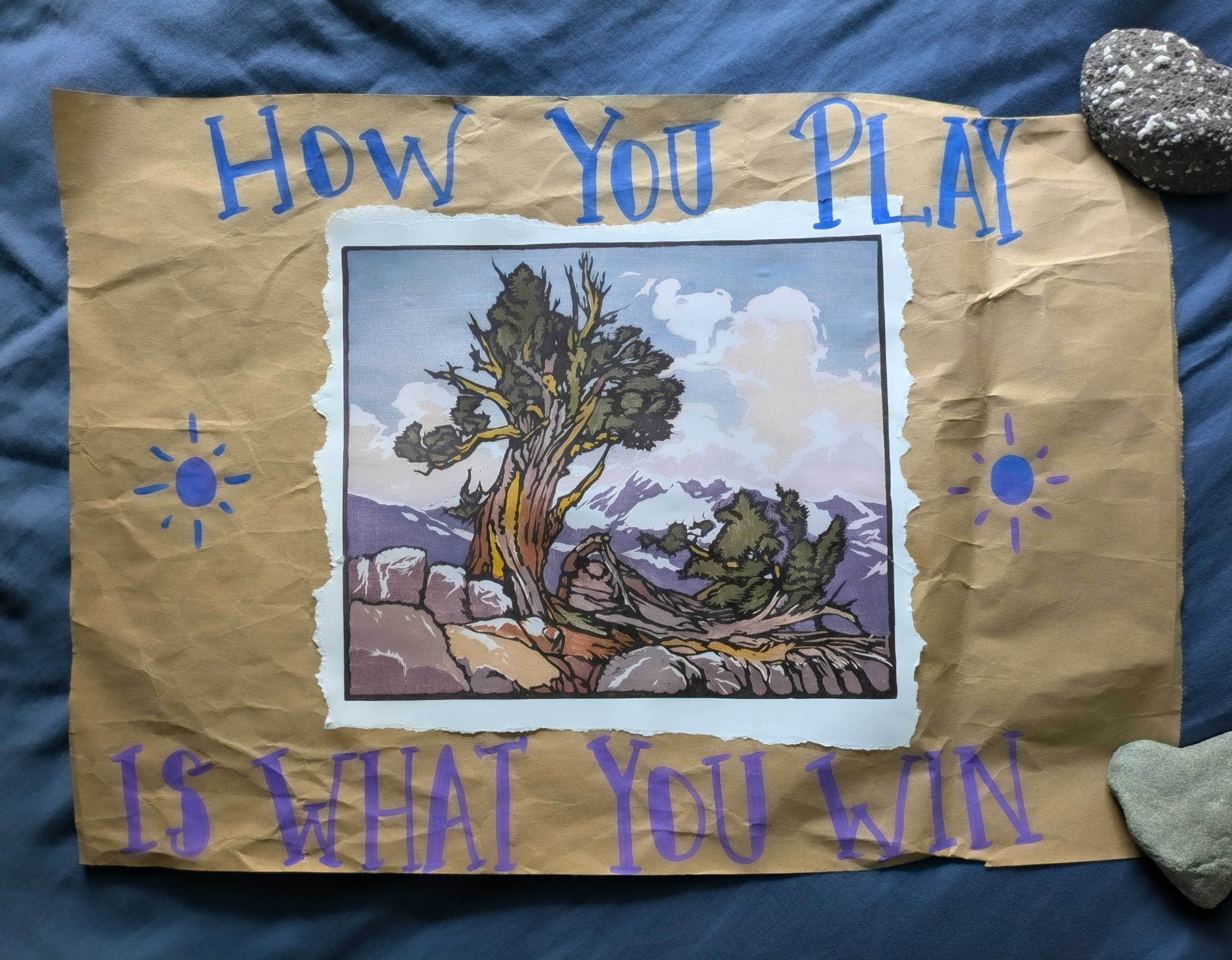
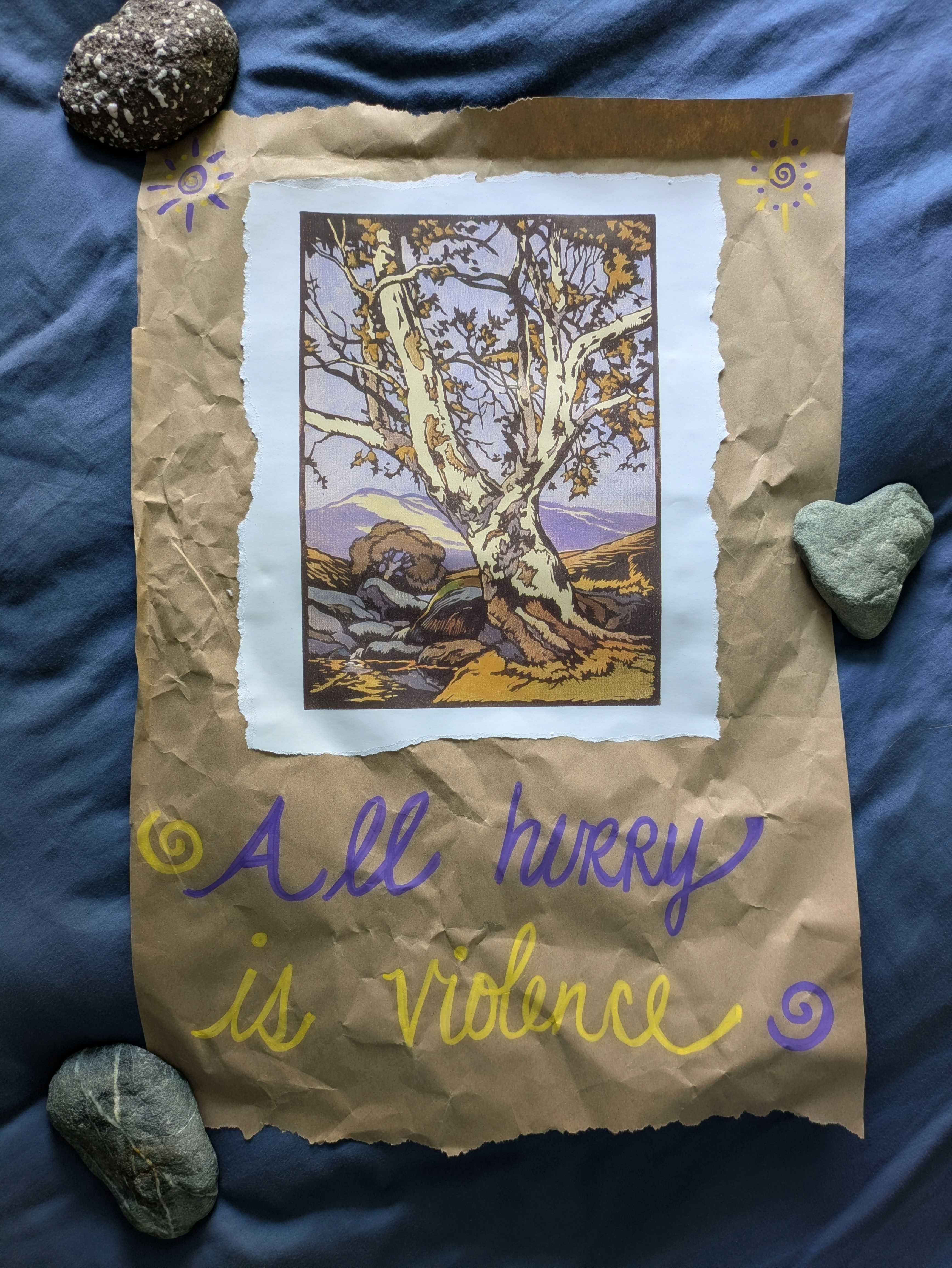
I have two more, equally tested and true. “How you play is what you win.” “All hurry is violence.”****
Some people have verses of scripture that guide them. I have these. How do I know they are good guides? When I consult them on a problem, I can point my inner compass in a more-right direction. They help me make choices that accord with my core values. They, too, are written on my heart.
And now they’re written on big sheets of packing paper, paired with some calendar reproductions of cool old block prints that speak to me deeply, and hanging (for the moment) on my wall. A slightly-fancier-than-usual sketching of the truths that hold and guide me in the threshold moments. This is triptych #4.
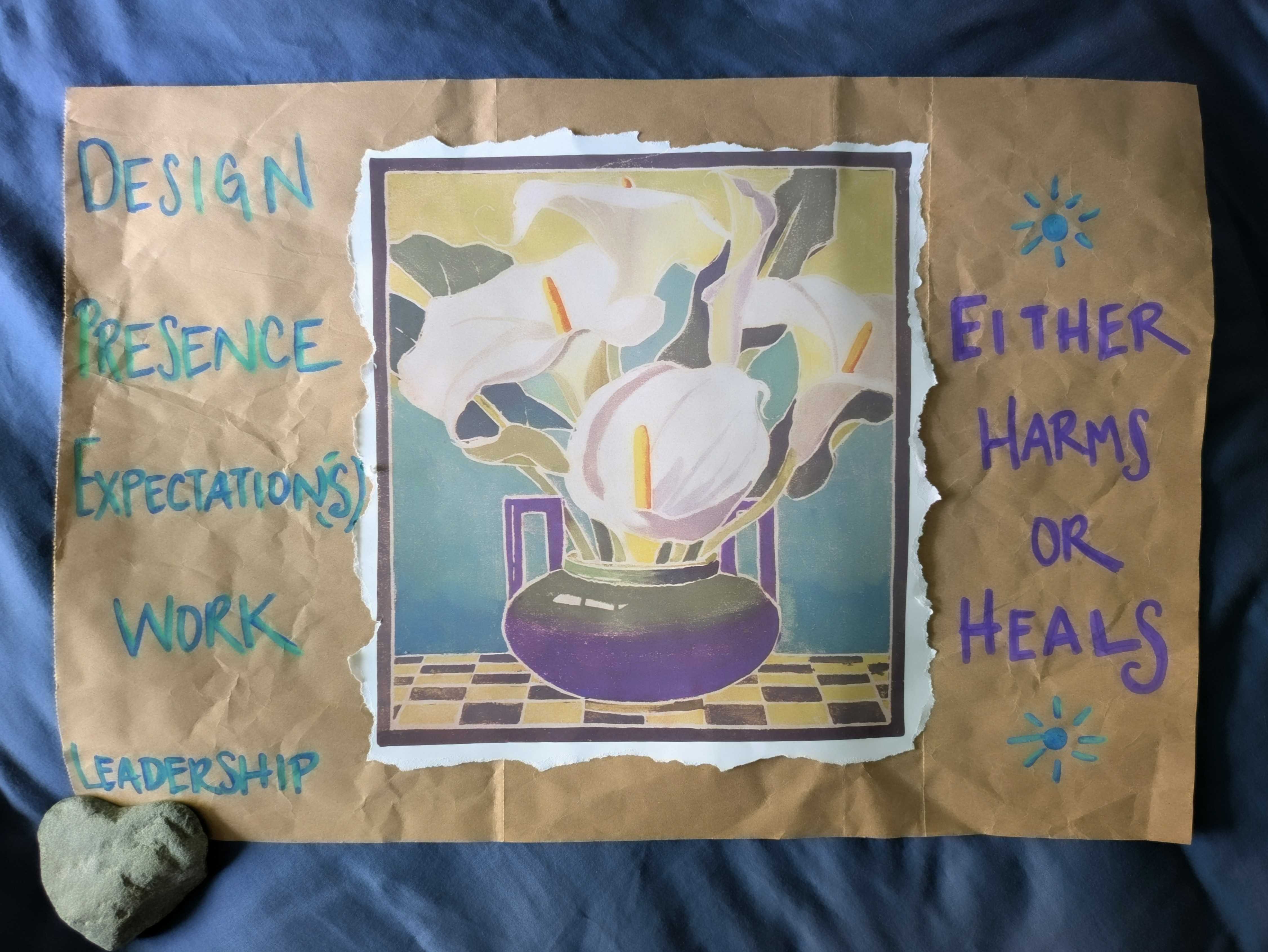
“How you play is what you win” comes from a short story by the wise (and so quotable) Ursula K. LeGuin. “All hurry is violence” is a particularly pithy formulation of an idea I’ve encountered in many contexts. The block prints referenced are by William S. Rice, of primarily California landscapes, made between the late 1800s and early/mid 1900s.
*As you may or may not remember, the 2010s were a Different Time™.
**Confirmed by how quickly the tech industry (and so many others) pivoted to obvious selfishness and greed the moment it became profitable to let selfishness and greed show.
***It’s a deeply right thing to interrogate why you want to build a product, or hire a team, or create a new program. And it’s right to build structures to help identify when you’re on or off the path you’ve collectively set. And whether it’s still the right path, and why or why not. I’d argue that an organization cannot do good work in the world without this kind of framework, and the discernment that periodically needs to go into it. Ask me about this any time. I love this stuff.


I received your lovely postcard. Thank you! Christina
LikeLiked by 1 person