This time last week, they were all just Canada Geese.
I’m sitting in the back of a US Fish & Wildlife pickup, staring through binoculars at a milling bunch of branta canadensis in a dairy farmer’s field. In the front seats, two other volunteers are conferring. “Mixed flock,” says our team lead, undoubtedly for my benefit. Clicker in hand, he begins to count them. “215 Aleutian. 18 Cacklers. 26 Dusky.”
I’ve read the literature. It has color illustrations, which make our 6 wintering subspecies of Canada goose and Cackling goose reasonably easy to distinguish. Knowing it would be harder in the field, I memorized a bunch of characteristics to use as a key. Dusky Canada geese are dark in color, smaller than Westerns but bigger than everybody else. Aleutian Cackling geese have a blocky head and sometimes a white collar. Cackling Cackling geese are the size of a mallard, with very short bills and “puffy-looking” heads. They might also have a white collar. Etc.
I’m cataloging 259 actual live geese right now, and I can’t tell the difference. Which is great, in fact, because it means I have something intricate and specific I’m about to learn.

This is the White-Cheeked Goose Survey at Nestucca NWR, which the US Fish & Wildlife Service* has conducted every year for the past 20. They count subspecies and specific locations, every two weeks from October through April. I got involved because local wildlife is part of my job.
I mean my new job: the one I’m making up.
***
I’m really here because I lost the job that actually paid me money.
It was a tech-industry layoff; c’est la vie. It happens all the time (it shouldn’t), it’s happened to me at least twice before, and no more needs to be said because it’s not that interesting. What’s been interesting this time is that finding another employer is shockingly hard. I’ve been forced to figure out more than just “what’s next for my career.” I’ve needed to engage in deep and sustained discernment.
I don’t lack for work—I’m a creative coach, a poet, an aspiring novelist; a householder, a friend; a spouse and a family member. That’s all part of the work of my life, and I love it, and I can fill the archetypal 40 working hours of a week with it, no problem.
But the lack of employment has me baffled. I like working on a team. I like working toward shared goals, with action items and methodologies determined by the group. I like solving problems, talking about ideas, cooperatively figuring out the why and the what and the how.
I don’t miss directives to build whatever vaguely-useful product or experience shareholders imagine will make them a lot of money. But I do miss the sense of purpose that comes from a shared and structured project. My husband likes to say that he doesn’t dream of labor. I do. Good work is part of my purpose in this world. There’s something lacking in my life without that connection.
Since this is America—where people lose their healthcare and their homes if they don’t have an income—of course I went looking for good work with a paycheck attached. And I haven’t found it.
I’m skilled, I’m smart, and I know a lot of people. That helps me have an interesting life, but I’m still unemployed. I’m 41 years old; I haven’t lacked an employer for more than a week since I was 18. So one thing I have right now is this amorphous time, to figure out the sort of employment I actually want.
It turns out that part of what I want is to steward and to advocate for the land—and the watersheds and the sea margins—that I love, and that physically and spiritually sustain me.
Potentially, there’s employment to be had here. But I don’t have an advanced science degree, and I don’t have a lot of experience yet, working in conservation. I also don’t want to wait for permission (read: paycheck) to do the work. I have a lot to learn, and a lot to give. So I’m making up a job where I get to do both of those things.
***
Learning from a book is great. But I learn truest by doing.
I want to learn things like: What are the mechanisms by which we understand species’ population dynamics, and the specific ways human interaction impacts the other-than-human world? How do we decide how and why to ‘manage’ those relationships—and then how do we accomplish the actual management? Who are the various human stakeholders? What is conversation between them really like? How do environmental science and conservation actually get done?
Asking those questions brought me here, to six hours in a slow-moving pickup truck on the last of this January’s still and wintergold mornings, counting geese.
Fortunately, no one is relying on my counting, or my ability to identify subspecies. My job has turned out to be accurately determining goose locations, by mapping our progress onto a printed-out satellite picture with field-borders drawn in. This also lets me track the progress of our survey, as in: “Hey team, we missed field R-5.”
(One reason this matters is the practical management of the refuge, which is, in part, a cooperation with local dairy farmers, who can submit claims for compensation if the geese eat all their grass. Refuge-owned and farmer-owned fields sit side-by-side. We want to know where the geese are actually foraging.)
I’m pleased that I have something to contribute today, besides my ten thousand questions.
***
I found the goose survey through a local organization here on the north coast, the Friends of Netarts Bay WEBS (that’s Watershed, Estuary, Beach, Sea). One of the amazing things about my quest to learn and to serve is how willing folks are to open a conversation. In this case, WEBS’ Communications and Stewardship Coordinators enthusiastically agreed to meet with me when I cold-emailed them with a bunch of questions. I went to their office in Netarts, where they got me fired up about community science, and then connected me to a bunch of people and programs.
Within days, I was learning how to do marine debris survey with one of their board members. I’m still mildly surprised to find that I enjoy it. I like setting up transects, I like categorizing objects, I like constantly kneeling to look really closely at the sand. I like the combination of working outside in a loved place, and working with care inside an established methodology. I used to do a little archeaological surveying, ages ago. Marine debris survey reminds me of that.
Maybe my favorite part, though, was the woman who came jogging up the beach to ask what we were doing. She had a bet going with her friends. She lost the bet, but she was excited: “Oh, you’re scientists!” One hour on the job, and I’m mistaken for a professional. What a delight.

I tried to let my experienced companion fill in most of the details. Also, I was too excited not to share. A good conversation is one of the best things in life. And teaching and learning are both favorite occupations.
So my new job also involves periodically categorizing trash on my home shores. Lots of people do this, all over the world, under the aegis of the National Oceanic and Atmospheric Administration.* Our work contributes to a growing communal knowledge of the significant, shared global problem of trash in our oceans, and how to most effectively alleviate it.
Other days, my job is helping to restore native local wetland and forest habitat. People with actual deep understanding of how to do this are directing my work (thank goodness), which includes things like: pulling escaped grapevines out of conifers, or cutting and digging the wildly invasive (and painfully spiky) Himalayan blackberry.
Working with the North Coast Land Conservancy on this last, we recently freed an entire wetland behind NCLC’s Conservation Center. Think about the scene in the Disney Sleeping Beauty where a wall of thick briars grows up in minutes around the cursed castle. Himalayan Blackberries, removed to the Pacific Northwest, do something less dramatic—but not by much.
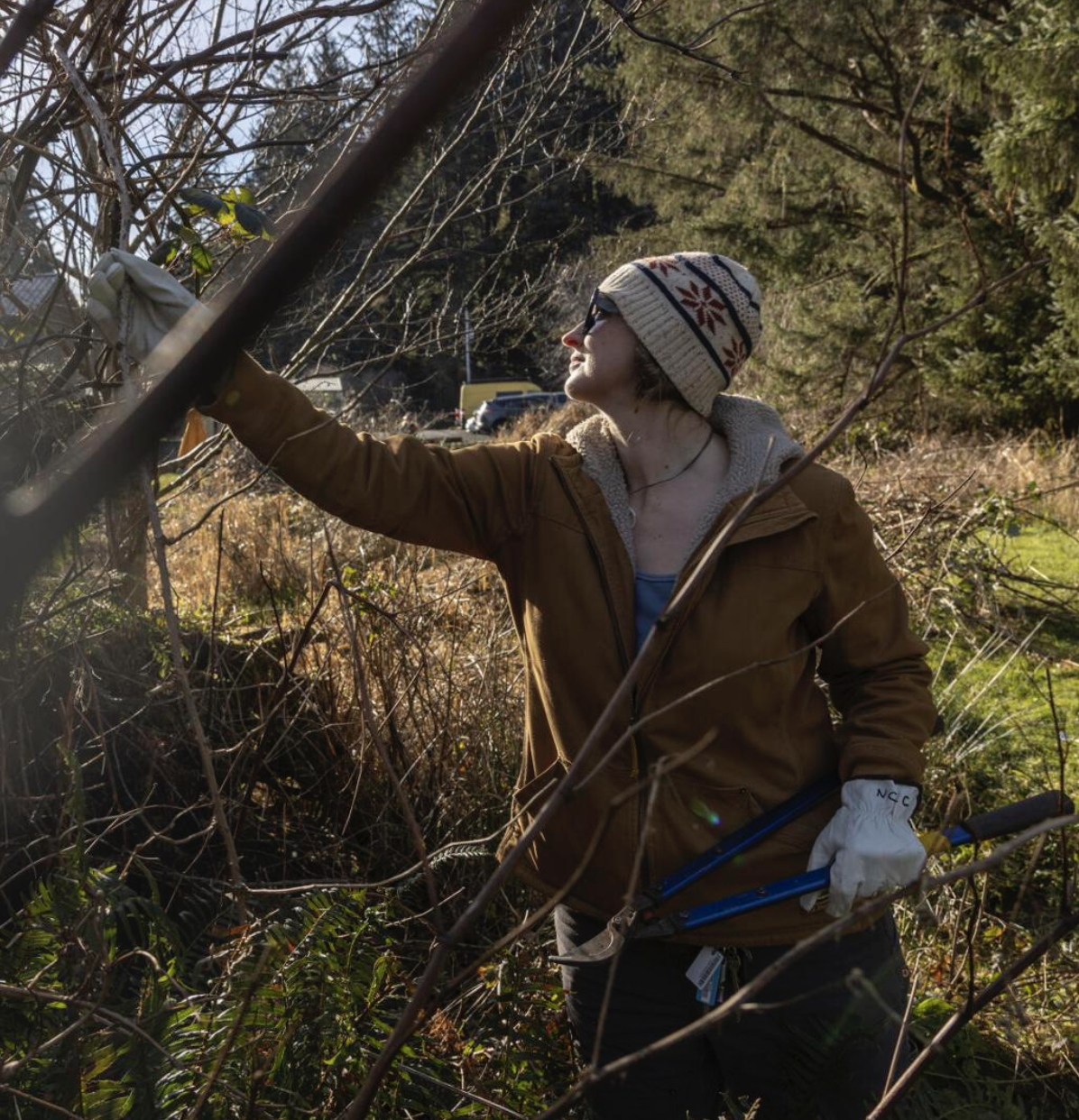
I’m doing less outdoorsy work too: cataloging art donations at the public library, and various writing-related tasks for conservation orgs. I love these projects. Partly because of their relative complexity; I have to understand the why of them, and figure out the parameters, before I can start.
There’s something uniquely focusing, though, about fieldwork. This isn’t a new understanding, but it’s not a familiar one, either, so I’ll be cautious about drawing hard conclusions.
I’d like to say it’s the whole-body attention of it, the way my mind and hands and muscles are working to accomplish just the one specific task—dig that blackberry out by the roots—at a time.
It doesn’t have to be particularly physical, though, to create the focus. Looking at geese today, I’m mostly in the car. Sometimes we get out and set up the spotting scope. But we’re not hiking, or exerting our physical selves much at all, and I’m just as in-the-moment as I feel when I’m pulling and sweating. There’s room for not much in my cognitive brain except geese—counting, mapping, field-naming, failing to identify—and that’s a particular species of relief. I’ve got a brain that spends most of its time cartwheeling six ways to Sunday, on three to seven topics at any given time. It’s a pleasure to rest in the pure focus of a task I can only do with my full attention.
And a pleasure to discover things, in the flesh, in all their wonder. Have you ever seen, for example, a Dusky goose? I mean really looked at one? They’re gorgeous. Deep bronze breast feathers, gently sparkling in January sun. Until this moment, I had no idea.
Earlier, I called this “spiritually sustaining.” Beauty—and wildness, and otherness—matters to our souls. Or whatever you want to call that part of you that lifts when you hear a wind rising in the forest, or a haunting progression of chords, or geese calling on the wing at the start of autumn.
Beauty is everywhere in this burning world, surprigingly robust and terrifyingly fragile. I love how closely my present job allows me to be constantly looking for beauty—and wildness, and otherness—and learning to care for it, in the very small ways that I can.
Which are somewhat less small because they connect to explicity cooperative, community-driven efforts—undertaken through time and with forethought, and accompanied by regular thoughtful evaluation. We do not always succeed, but the goal is always to do just a little bit better—at reciprocating the gifts we are given, merely by being born into this world.
I have no idealy, truly, what’s next for my career. I’m glad, right now, to live in a landscape I love, learning and attending and conversing and doing right work. I’ll keep you posted.
*Assuming they’re allowed by the current administration to a) keep their data live, and b) exist.
 Tara K. Shepersky
Dearest Tara ~ I can’t even count the ways I love this recent share from you! It’s the first thing I opened this morning with my steaming blue mug of coffee beside me. I was thinking to myself, “What do I want to read this morning to start my day… to center me … to inspire me and fill me with appreciation?” And there you were! The entire piece just fills me with delight and a buzzy excitement… for you and how you are once again stepping out so fully in faith and really recognizing what fills your cup and your heart! This is what the world needs a big dose of right now… this is what lifts people who are doing meaningless work (with fat paychecks or not) out of a numbing, stale, bored place of apathy and despair! With every ounce of my being, I am certain this grand exploration of yours is going to reveal openings, connections, opportunities, and some of the richest satisfaction you have ever known! You have so very much to bring to this work… your fine and curious mind; your sensitive and attuned observations; your beautiful capacity to express what you see and feel in word and image. Yes, yes and yes! I am printing out this particular post to re-read, because it inspires me and because I can really wrap it around you with a lot of energy and steadfastness! And oh – by the way… did you notice in the photo of you kneeling on the sand that there is a the most perfect raptor shape that has manifested in your shadow behind you?!? Grateful for the gift of you! Melissa
LikeLiked by 1 person
Thank you. All of that *I* need to hear. <3
I hadn’t noticed the hawkshadow! I love it.
LikeLike