The short essay below is a re-print from the March 2025 Alder Creek Farm Community Garden Newsletter, produced by Lower Nehalem Community Trust. Alder Creek Farm is in Nehalem, Oregon, very close indeed to my actual backyard. The original audience for this piece is other gardeners, so here’s some context for those who don’t know us:
- Alder Creek Farm is a community garden in a different-to-the-usual sense. Instead of tending individual plots, we all garden toward the same overall plan for the 1-acre farm. We feed not only ourselves, but the soil, the health of the larger ecosystem, and our human neighbors.
- Roxann is our Row Garden Lead and general all-around amazing volunteer leader
- Alder Creek Farm is one of several properties owned and actively stewarded by the Lower Nehalem Community Trust (LNCT), a very-local-to-me land trust I work with as often as possible, in various capacities.

The Living Dirt
“Do you know what this is?”
Roxann and I are standing in the row garden. I’ve just finished weeding exactly one row, and my lower back is done. I get a break, though: Roxann hands me a metal tool about a foot long, and while I don’t know precisely what it is (I’ve never seen one), it sure looks like something made to take core samples.
“Yes!” I say—a declaration that is partly true and partly aspirational.
We discuss sampling methodology and locations (I’m still new here; which one is Field 3?), and I spend a pleasant twenty minutes with my soil sampler, happily playing scientist. When I report back, Roxann says to take my samples to the greenhouse, where someone will perform NPK testing.
“Can I do it?” The words are out of my mouth before I’ve properly thought them. Roxann looks something like devilish and something like delighted when she says yes.
NPK stands for Nitrogen-Phosphorus-Potassium.* Those three elements are primary plant nutrients, and the ones that tend to get depleted most quickly from soils that feed plants. Depending on the crop, or depending on its particular needs during the growing season, you’ll likely need to add amendments that contain more of one than the others.
Another thing we’re testing for is pH—short for potential hydrogen—which, in the context of a garden, is a measure of how acidic (low pH), neutral, or alkaline (high pH) a patch of soil is. Our blueberries need fairly acidic soil (4.5 to 5.5), our fruit trees like slight acidity (6.0-6.5), and some crops (kale, for example) tolerate a little alkalinity just fine.
Testing our pH and NPK levels at the beginning of the growing season lets us fine-tune our soils in different parts of the garden, setting our crops up for success.
I began my temporary career as amateur soil scientist with no idea how to perform these tests. But I’m discovering (to my own delight) that this fazes no one at Alder Creek Farm. Don’t know how to do something? We’ll teach you. On that first day in early March—accidentally excited about soil—Roxann and Gail and Mark between them taught me where to find our testing tools, how to use them, and how to interpret results.
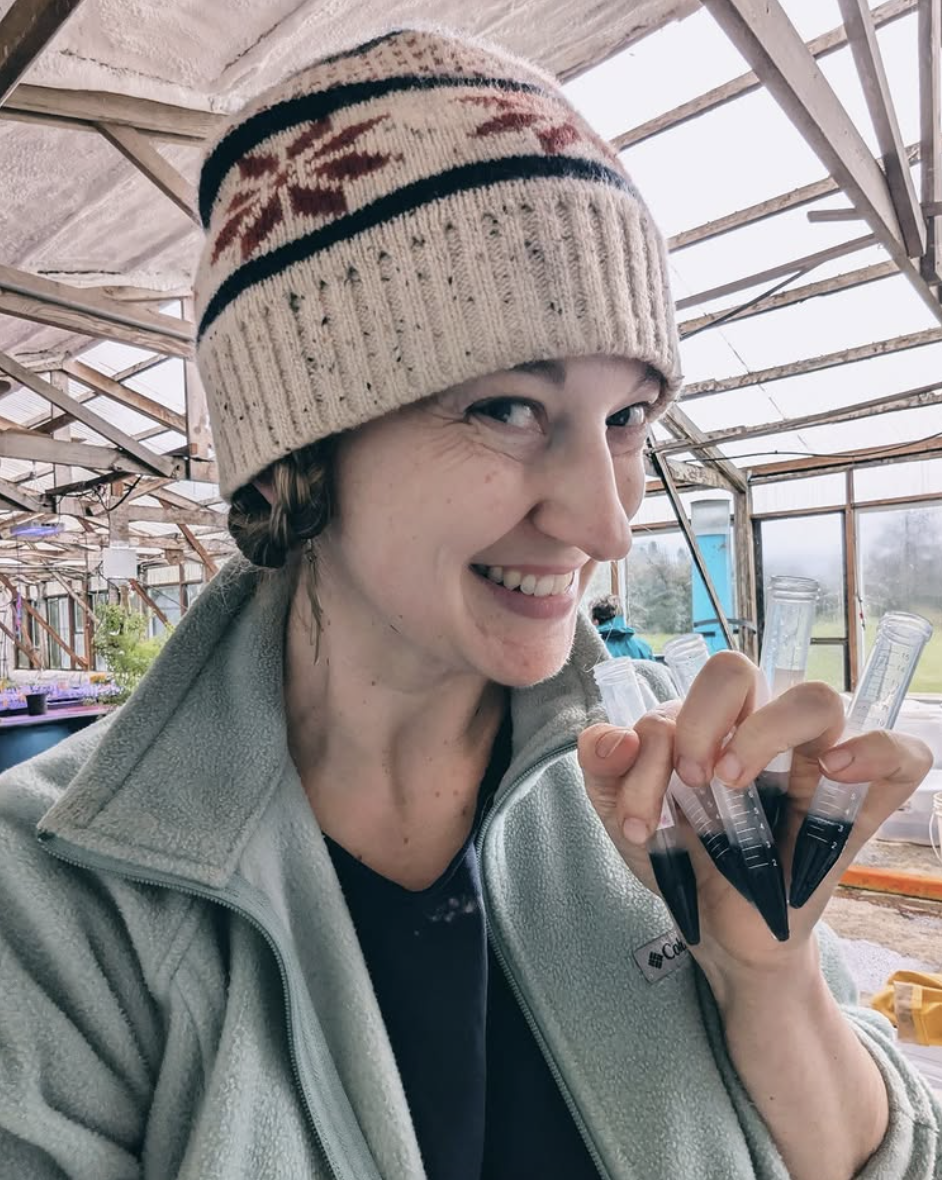
And the rest I’m figuring out as I go along. I never finished a chemistry class in my life, but I do like sampling, surveying, precision. And learning new things. Testing soil turns out to be a lot of logic, focus, and following directions.
My life’s intense lately, so I especially love the focus part, the restfulness of that. I sit in my warm corner of the greenhouse, organizing and documenting, setting timers, and just quietly waiting. Occasionally I get to pop out into a light rain for fresh samples. There’s an element of project-planning, too, which I enjoy: figuring out the process, timing, and space-sharing logistics for setup, sampling, testing, cleanup, and usefully recording results.
I love these days when I get to do our soil-testing. For a few hours on a Tuesday or a Saturday, there’s no room in my brain for worry, or the dozen projects that drive me most of the time. Just the living dirt.
*Yes, K is the chemical symbol for Potassium. It comes from a neo-Latin word, kalium, which in turn comes from an Arabic term for “burnt ashes” or “plant ashes”—what we also call potash.
 Tara K. Shepersky