It’s raining. Of course. This is March on the Oregon Coast. There’s grit in my teeth, and white calcareous dust streaking my clothing. My nose and my hair and my dorky-looking safety glasses have beaded up with water; the nearby ocean is only visible as a gray and white blur.
My hands are full, so there’s nothing I can do about any of that. I’ve been hoisting and hauling 20-pound bags of oyster shells for the past two hours, walking up and down the same stretch of isolated beach. I’m so, so happy.
I am not, technically, doing this for fun. Though it is fun: the focus and the physical work of it. And the silence that can only be found outdoors. And the company, which rotates irregularly between nobody at all and six other interesting people.
We are today’s Plover Patrol: a loose group of folks representing the Bird Alliance of Oregon, Oregon State Parks, and community science volunteers. We are here together for a tiny, threatened shorebird: the snowy plover.
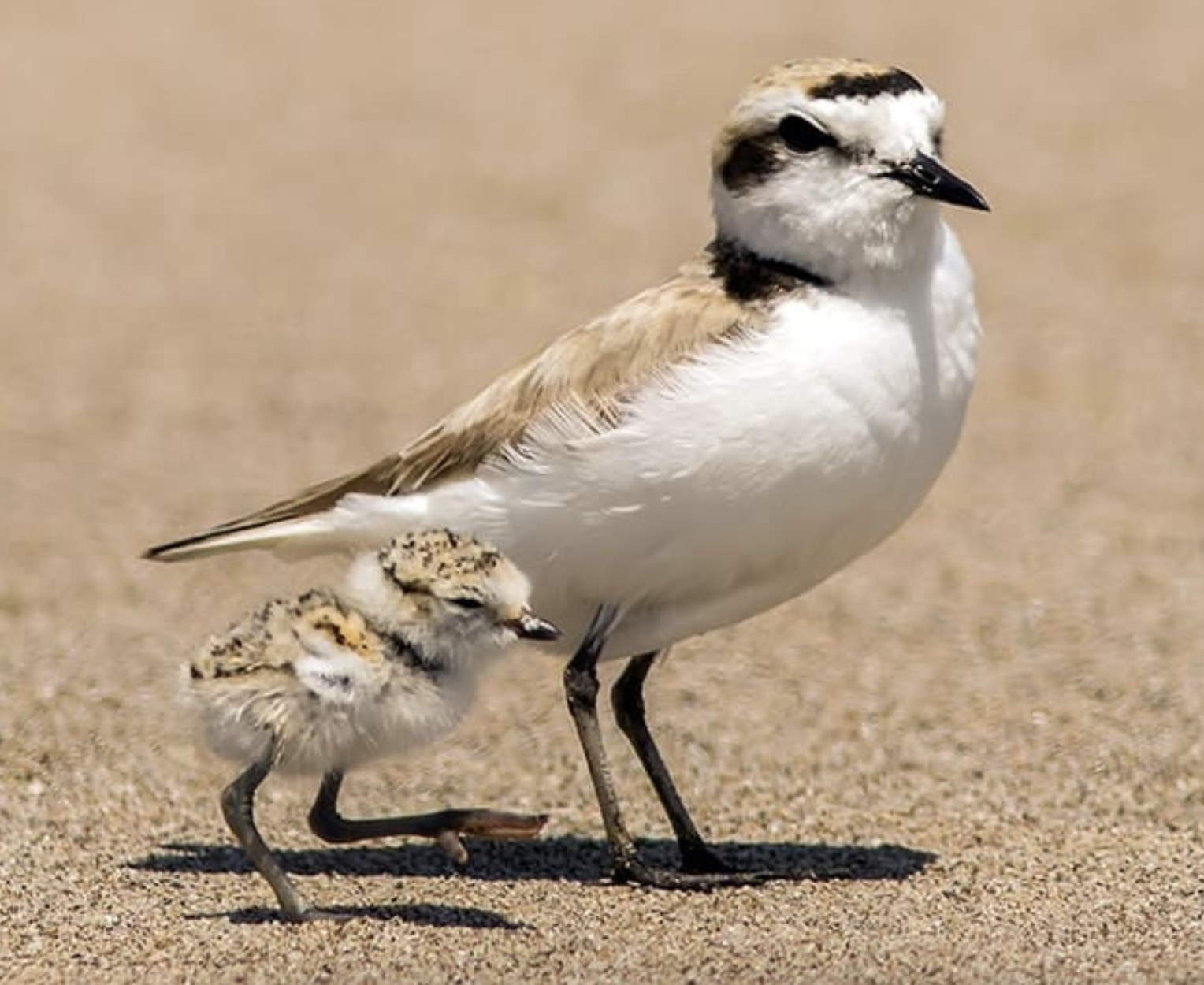
Snowy plovers (Anarhynchus nivosus) are a conservation success story. In the state of Oregon, they’re back from a low of 50 or fewer individuals in the early 1990s, to a (still quite vulnerable) population of about 500. That success is directly attributable to the Pacific coast population’s federal listing as a threatened species under the Endangered Species Act, and a whole lot of targeted work by federal, state, and non-profit organizations.
That work is a continuous cycle of figuring out how to help the birds, getting the funding for it, doing it, and evaluating scientifically whether it’s working. It involves careful study design, data collection, and analysis. It includes grant-writing and community interpretive programs and signage design. It requires coordination between dozens of agencies and organizations. Also a lot of volunteers, of which I am now one.

Usually, Plover Patrollers are out looking for birds and nests, but that’s not today’s mission. Today’s work is shell-scattering: adding organic debris to a plover Habitat Restoration Area, in the (educated) hope that a little camouflage will increase this year’s nesting success.
The first thing I knew about plovers was that they like to make their nests (called scrapes) in the open sand, not far from the water’s edge where they get their sustenance. The fact that humans recreate freely on nesting beaches doesn’t change the plover-parent imperative.
Plovers don’t like dense cover, but they do like a little natural debris to break up their predators’ sight-lines. And something else humans tend to do on our beaches is keep that stuff picked up. So that’s what the Plover Patrol is doing today: adding shell debris that we hope will encourage plovers to make their nests on this protected beach.
Studies from the state of Washington indicate that shell-scattering increases the number of plover chicks who survive to adulthood. It hasn’t been tried on Oregon’s north coast before. This year’s Plover Patrol surveys will pay special attention to whether scrapes are located near the scattered shells, and whether those nests are more, less, or equally successful, compared to nests without shell debris.

*
I haven’t done this before either, and I want to get it right. For the plovers, you know? So as we’re loading and unloading bags of shells from ORPD vehicles, I keep asking things like How many shells at a time? How thickly should we cover a given area? Is it random, or are we going for a loose pattern?
Cara Gates, Bird Alliance’s Coastal Community Science Biologist, laughs. “Don’t think too hard about it!” she advises cheerfully. This is impossible for me, so instead I watch her slit open a bag of shells, dump them in a bucket, and head off up the beach, casting and scattering. When I have a sense of it, I hoist my own bag and follow.
At first I’m literally counting, brain scrambling for any kind of pattern. But Cara’s right: where the shells land is both intuitive and just not that big a deal—at least as far as our science understands. I relax into the work, enjoying the physicality of it, smiling at the rain on my face.

*
There’s a window for this work: after the big winter weather that might bury our shells, and before nesting season starts on March 15. We don’t expect to see any plovers today, but we hope they’ll notice the shells, and want to use them. That’s the first part of our “nesting success” goal: attract the plovers to areas that have been restored to ideal nesting habitat conditions.
The second part is to lower the significant predation pressure they experience from the sky and the nearby vegetated edge: crows, ravens, coyotes, skunks, raccoons—et cetera.
Of course, it’s normal for shorebirds to lose a lot of eggs and chicks to predators. But the number and density of predators now is greater than plover populations can sustain. With non-native human settlement came non-native predators—cats, Virginia opossums, red foxes—who love a protein-rich plover egg as much as any native raven. Humans have also provided subsidies (food, shelter) to our native crows and ravens in particular, allowing them to substantially expand their own populations.
So it’s hard for plover parents to raise enough chicks, with more hungry mouths than ever hunting them down. Add shrinking habitat from relentless coastal development and rising sea levels, plus nest disturbance by beach-going humans and dogs, and you’ve got one vulnerable little shorebird species.
A conservation success story they may be, but it’s provisional. Snowy plovers are still struggling to reach a number that will let them recover a sustainable population.
*
By the time we finish scattering 100 bags of oyster shells, pack up our trash, and put away our tools, the rain’s let up. Someone produces a pink box of donuts. The sand’s too wet to sit on, so we stand around companionably trading stories, enjoying the shared lonesomeness of the dunes and the waves and the purple mountains.
I am not a scientist. A year ago, I had only the vaguest idea this kind of work existed. I’m not even a birder. I’m an amateur naturalist with a soft spot for shorebirds, and abiding curiosity about my human and non-human communities.
I’ve come to this beach through happy accidents, strangers who are generous with their knowledge and their time, and a whole string of unexpected circumstances this past year and more. My compensation is donuts and joy, and the continuance of my ecological education. And imagining this year’s hopeful plover-parents, zipping out to investigate our work the moment we leave—and deciding to stay. Today, I get to be a generous stranger, too.
I pick out a glazed donut covered with multi-colored sprinkles, not a choice I’ve made in recent memory. It’s delicious, even with the inevitable crunch of sand between my teeth.

 Tara K. Shepersky
Precious moments of helping nature
LikeLiked by 1 person
Love your writing. Thanks! Tim Colman goodnaturepublishing.com
LikeLike